BREAKING: Anambra State Government Unveils Fresh Debt Records and Counters Peter Obi’s N2.13bn Ecological Fund Claims
AWKA, NIGERIA — The political atmosphere in Anambra State has intensified as the state government issued an official counter-statement dismissing claims made by former Governor Peter Obi regarding the financial position he handed over in 2014. The state government directly challenged Obi’s assertion that his administration left over ₦2.13 billion in an intact ecological fund account, providing official bank records and Debt Management Office (DMO) loan breakdowns to refute his claims.
The dispute escalated after Peter Obi publicly released the details of a First Bank account (Account No. 2018779464), claiming it held over ₦2.13 billion set aside specifically for ecological projects, including the Oko/Umuchiana erosion crisis. Obi insisted the money was left completely untouched for his successor, famously declaring that he would abandon his presidential campaign if anyone could prove otherwise. Responding directly in an official statement titled “Gov Peter Obi and Record of Public Debt in Anambra: Facts Beyond Propaganda and Lies,” the Anambra State Commissioner for Information and Value Reformation, Law Mefor, revealed that certified bank printouts contradict the former governor’s assertion. Mefor stated that the state obtained a certified printout of the account from inception to date, proving it is an Internally Generated Revenue (IGR) Consolidated Revenue Account, not an ecological fund account, and that from 2011 when the account was opened until date, there has never been any such amount—whether as inflow or balance—in the account. The state government subsequently challenged Obi to explain where the ₦2.13 billion was actually deposited if it never passed through the specified account.
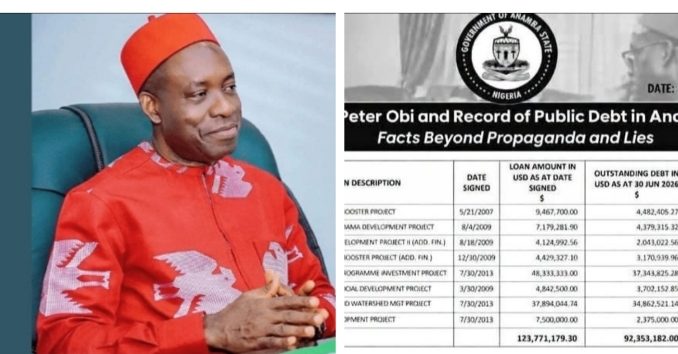
Addressing the wider narrative surrounding legacy state debt, the Anambra State Government published official records outlining multi-lateral loans obtained during Obi’s tenure that remain active debt obligations. According to the state government, as of June 30, 2026, the outstanding balance for these specific inherited external loans stood at ₦127.4 billion at the official exchange rate. These ongoing loan obligations include major development initiatives such as:
- Malaria Control Booster Project — Healthcare infrastructure facility with active repayment ongoing.
- Health System Development Project II — Primary healthcare expansion program with active repayment ongoing.
- Third National Fadama Development Project — Agricultural development funding with active repayment ongoing.
- State Education Programme Investment (SEPIP) — Educational reform initiative with active repayment ongoing.
- Community and Social Development Project — Rural infrastructure development with active repayment ongoing.
- Nigeria Erosion & Watershed Management (NEWMAP) — Environmental and erosion control facility with active repayment ongoing.
- Value Chain Development Programme (VCDP) — Agricultural value chain funding with active repayment ongoing.
The government noted that while these facilities were tied to genuine development initiatives, they represent real, long-term debt liabilities that subsequent administrations, including the current administration under Governor Chukwuma Soludo, have had to service. Furthermore, the state government contested Obi’s statement that his administration left office owing zero naira in salaries, pensions, contractor liabilities, or gratuities. Officials revealed that while the Obi administration verified and certified 16 months of salary arrears for primary school teachers, it paid only 5 months before handing over power. Similarly, legacy salary arrears from the former Water Corporation persisted through the Obi administration and resulted in court judgments that required financial settlement by the current administration. Commissioner Mefor noted that the Soludo administration has spent over ₦22 billion clearing inherited gratuity arrears accumulated from legacy administrations, including Obi’s tenure, while dismissing Obi’s signature claim of leaving ₦75 billion in liquid savings and investments as “nebulous creative accounting” unsupported by official state hand-over records.
This latest exchange represents one of the most detailed financial accountability clashes between the current Anambra State administration and former Governor Peter Obi. Obi has maintained that his administration operated with financial discipline, clearing over ₦35 billion in historical debts while avoiding commercial bank debt. However, the state government maintains that public accountability requires distinguishing between political narratives and verifiable balance sheets certified by financial institutions and the Debt Management Office. As public debate grows, both political observers and citizens await Peter Obi’s official response to the certified bank statements released by the Anambra State Government.
