
INEC ICT Director Reveals How AI-Generated Photos Entered 2027 Voters’ Register
By Esang Victor
The Independent National Electoral Commission (INEC) has blamed some of its registration officers for the appearance of artificial intelligence-generated photographs and other questionable records in its preliminary register of voters ahead of the 2027 general elections.
INEC’s Director of Information and Communication Technology, Dr Lawrence Bayode, disclosed this on Friday, October 30, 2026, during an interview on Arise Television, explaining how the suspicious photographs found their way into the electoral database.
According to Bayode, some registration officers across different states allegedly used their official login credentials to introduce irregularities into the voter registration system.
He explained that the officers had authorised access to the registration platform because their responsibilities included capturing and registering eligible voters. However, some allegedly abused that access, allowing questionable photographs and other records to enter the database.
Bayode said the commission uncovered the irregularities through its Automated Biometric Identification System (ABIS), which was deployed to examine voter registration records and identify suspicious entries.
He clarified that not all the questionable photographs were generated using artificial intelligence, as some resulted from what he described as very poor registration practices.
“Some of these pictures are AI-generated. Some of them not AI-generated, but very bad registration. And this thing got into the register by the registration officers and because they have access to register people,” he explained.
The ICT director further stated that INEC had identified how some of the irregularities occurred, although he could not establish the reasons behind the actions of the officers involved.
“When the ABIS was run on the system, we saw these people. We know what they did. We know how they did it. But honestly, I don’t know why,” Bayode said.
He maintained that the problem was not restricted to the locations initially highlighted on social media, noting that questionable entries had been identified in different parts of the country.
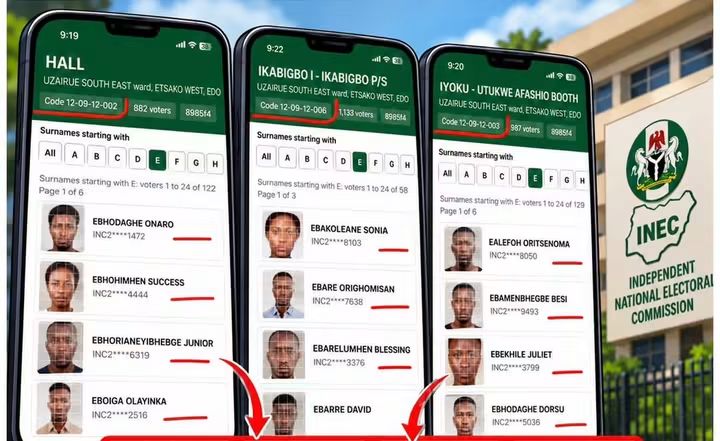
The revelation follows public outrage after INEC uploaded its preliminary register of voters to its website on October 26. Screenshots circulated online showed photographs suspected to be AI-generated attached to voter records in parts of Edo State, particularly in Etsako West Local Government Area.
The development raised concerns about the credibility of the voter database, with Nigerians questioning whether the affected records represented genuine registered voters and whether the individuals associated with them had collected Permanent Voter Cards.
Other complaints involved alleged duplicate registrations and reports from some registered voters who claimed their names or photographs were missing from the online register.
Responding to the controversy, INEC said it had identified questionable records during the physical display of the preliminary register conducted nationwide between October 9 and 15. The commission explained that the online publication was intended to complement the physical inspection exercise and that the uploaded document was not yet the final certified register.
Bayode assured Nigerians that the commission was working to correct the identified irregularities before the final register is published on December 15, 2026.
He also clarified that although INEC had not deployed artificial intelligence for voter registration, the commission was using AI-powered chatbots to respond to public enquiries and support certain aspects of election logistics.
The ICT director said the commission was committed to ensuring that questionable photographs and other irregularities were addressed before the final register is certified.
The controversy has intensified calls from political parties and civil society organisations for greater transparency, stronger internal controls and independent scrutiny of the electoral database.
For an election involving millions of registered voters, the integrity of the voter register remains fundamental to public confidence in the electoral process. INEC will therefore face pressure to demonstrate that the affected records have been properly investigated and corrected before the 2027 general elections.
