
SGF Inaugurates Presidential Security Committee, Demands Urgency and Professionalism
Reported by Facthabournews
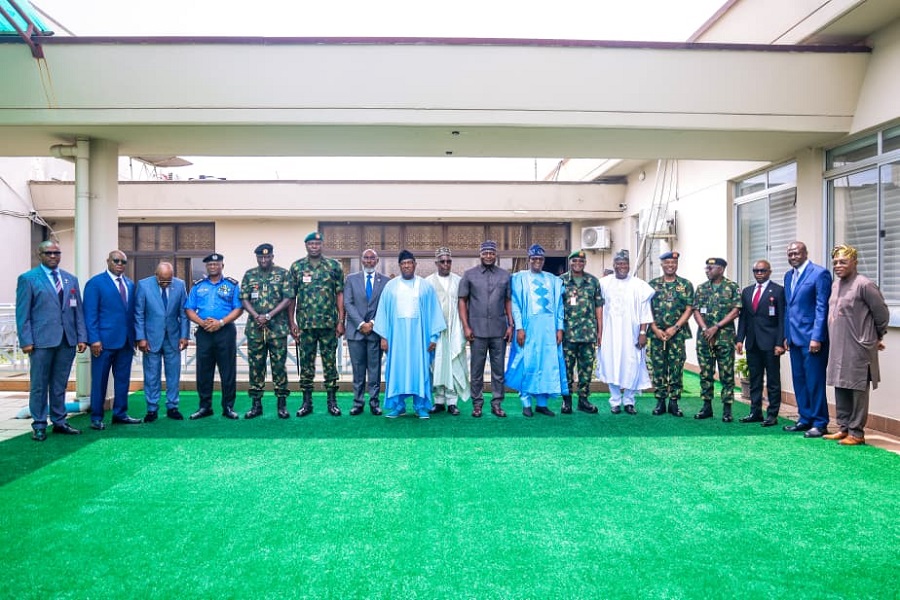
The Secretary to the Government of the Federation (SGF), Senator George Akume, has inaugurated a Presidential Committee on National Threat Assessment and a Five-Year Strategic Defence Operations Plan, charging members to approach the assignment with professionalism, objectivity, urgency and patriotism.
The committee was inaugurated in Abuja on Wednesday, August 26, 2026, on behalf of President Bola Ahmed Tinubu. It has been given 90 days to complete and submit the National Threat Assessment and five-year defence operations plan for the President’s consideration and approval.
Committee to Rethink Nigeria’s Security Strategy
Akume said the initiative was designed to strengthen Nigeria’s ability to understand, anticipate and respond to an increasingly complex security environment.
According to the SGF, Nigeria must move beyond reacting to security incidents after they occur and develop a system capable of anticipating threats, prioritising risks, deploying resources efficiently and measuring the results of security operations.
He said modern security threats were increasingly interconnected and capable of exploiting gaps between institutions, jurisdictions and operational theatres.
90-Day Deadline
The committee is expected to produce two major documents within the 90-day period.
The National Threat Assessment will identify existing and emerging security threats facing Nigeria, assess their urgency and strategic implications, examine how they could evolve and recommend appropriate government responses.
The Five-Year Strategic Defence Operations Plan will translate those findings into practical priorities, including the personnel, equipment, intelligence, infrastructure, logistics and technology required to address identified threats.
The plan will also identify capability gaps and establish procurement priorities based on assessed security needs rather than institutional preferences.
From Threats to Measurable Results
Akume said the government wants a clear connection between security threats and the resources deployed to address them.
“In simple terms, we must establish a clear path from threat to objective, from objective to capability, from capability to resource, and from resource to measurable outcome.”
The framework is expected to provide clearer implementation timelines, assign responsibilities and introduce mechanisms for monitoring progress and measuring outcomes.
The five-year plan will operate on a rolling basis and will be reviewed annually to take account of emerging threats, technological changes, operational realities and lessons learned from ongoing security operations.
Security Chiefs Make Up Committee
The committee is coordinated and supported by the Office of the President’s Special Adviser on Homeland Security, Major General Adeyinka Famadewa (retd.).
Its membership includes National Security Adviser Nuhu Ribadu; Minister of Defence Christopher Musa; Minister of State for Defence Bello Muhammad Matawalle; Chief of Defence Staff General Olufemi Oluyede; Chief of Army Staff Lt. General Waidi Shaibu; Chief of Air Staff Air Marshal Sunday Kelvin Aneke; and Chief of Naval Staff Vice Admiral Idi Abbas.
Also on the committee are Inspector-General of Police Olatunji Rilwan Disu, Director-General of the Department of State Services Tosin Ajayi and Director-General of the National Intelligence Agency Ambassador Muhammed Muhammed.
Focus on Better Coordination
The SGF noted that security agencies sometimes plan operational requirements independently without sufficient reference to a common national threat assessment or unified capability plan.
The new framework is intended to improve coordination between the Armed Forces, intelligence services, police and other security institutions.
Famadewa said his role would be to facilitate collaboration and harness the expertise of committee members rather than command them.
He also disclosed that specialised subcommittees would be established to handle different areas of the assignment and help ensure that the 90-day deadline is met.
What the Plan Could Mean for Nigeria
The committee’s work comes amid continuing security challenges across different parts of Nigeria.
Beyond identifying immediate threats, the government wants the assessment to highlight emerging risks that may require early investment in intelligence, technology, infrastructure, training and other capabilities.
The five-year strategy is also expected to guide defence procurement and resource allocation, potentially providing a more structured basis for deciding which capabilities require priority funding.
For Nigeria’s security personnel, the SGF said, the objective is to provide a strategic framework that clearly defines their missions and gives them the capabilities and resources required to perform them.
The effectiveness of the initiative, however, will ultimately depend on how successfully the recommendations are implemented after the committee submits its report.
For now, the 90-day countdown has begun, with the Federal Government expecting the committee to produce a comprehensive assessment and a practical long-term security strategy capable of moving Nigeria from largely reactive security operations towards a more coordinated and preventive approach.
This report is based on statements from the Federal Government and reports of the committee’s inauguration. The committee’s recommendations are yet to be produced and should not be treated as established government policy until formally approved.
