
Dollar Pricing Row: Marketers Suspend Dangote Fuel Loading as Federal Government Moves to Resolve Dispute
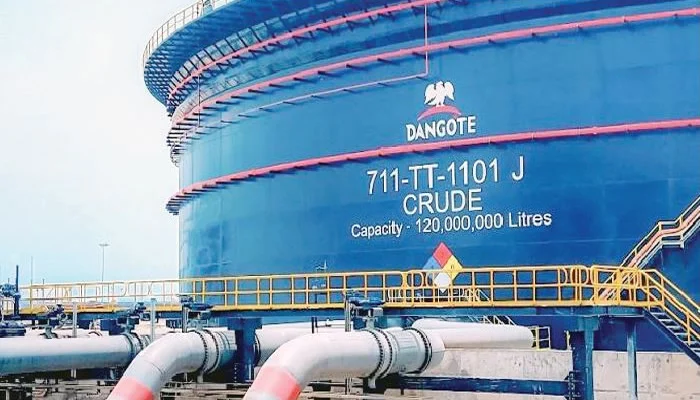
ABUJA/LAGOS – Fresh uncertainty has gripped Nigeria’s downstream petroleum sector as petroleum marketers suspended large-scale loading of Premium Motor Spirit (PMS), popularly known as petrol, from the Dangote Petroleum Refinery following the refinery’s decision to adopt a dollar-denominated pricing template for petroleum products.
The development has raised concerns over possible disruptions in fuel distribution and a potential increase in pump prices if the impasse persists. However, Dangote Petroleum Refinery has dismissed reports suggesting that loading operations had been halted, insisting that product loading at its Lekki facility is continuing as scheduled.
The controversy follows the refinery’s announcement that petrol, diesel and aviation fuel would henceforth be sold in United States dollars instead of naira. Under the new pricing template, the ex-depot price of petrol has been fixed at $0.779 per litre, diesel at $1.087 per litre, while aviation fuel is priced at $0.942 per litre. The refinery explained that the transition became necessary because a significant portion of its crude oil feedstock is now procured in dollars, making it increasingly difficult to continue selling refined products in naira.
Many independent marketers have reacted by slowing or suspending fresh purchases, saying they are waiting for clarity on the new pricing framework and the likely impact on retail fuel prices. The National Publicity Secretary of the Independent Petroleum Marketers Association of Nigeria (IPMAN), Chinedu Ukadike, said marketers were adopting a cautious approach because they could not accurately predict whether petrol prices would rise or fall in the coming days.
According to him, many marketers are still selling products purchased earlier at between ₦1,250 and ₦1,300 per litre, while new imported products and fresh crude supply arrangements may introduce different pricing templates. He warned that buying large volumes under the prevailing uncertainty could expose marketers to heavy financial losses if prices decline shortly after purchase.
Similarly, the Chairman of IPMAN’s Western Zone, Oyewole Akanni, disclosed that several filling stations in the South-West had temporarily suspended fresh purchases while awaiting further direction from the refinery. He explained that marketers have increasingly turned to private depots, where ex-depot prices now range between ₦1,200 and ₦1,250 per litre, excluding transportation costs, resulting in higher operating expenses for retailers. Despite the challenges, Akanni maintained that Nigeria was not experiencing fuel scarcity and urged motorists to avoid panic buying.
Responding to the reports, a senior official of the Dangote Group denied allegations that fuel loading had stopped at the refinery. The official described the reports as false, insisting that loading operations remained active and that marketers were free to verify activities at the facility. The refinery has also maintained that no marketer had yet completed a dollar-denominated payment since the new pricing template was introduced, arguing that some depot owners had increased pump prices even before purchasing products under the new regime.
Meanwhile, discussions between the Federal Government and Dangote Petroleum Refinery are continuing in an effort to resolve the dispute. According to sources familiar with the negotiations, the disagreement extends beyond pricing and includes concerns over the implementation of the naira-for-crude initiative, crude oil supply volumes from the Nigerian National Petroleum Company Limited (NNPC Ltd.), and the continued issuance of petrol import licences despite the refinery’s substantial domestic refining capacity.
Industry stakeholders warn that unless the outstanding issues are resolved quickly, prolonged uncertainty could lead to higher fuel prices, increased pressure on the foreign exchange market and further volatility in Nigeria’s deregulated downstream petroleum industry. Both marketers and consumers are therefore looking to the Federal Government and Dangote Refinery to reach a compromise that will stabilize fuel supply, protect consumers from sharp price increases and restore confidence in the petroleum market.
