
Quantum Computing: The Emerging Technology That Could Redefine the Future
By Fact Harbour News
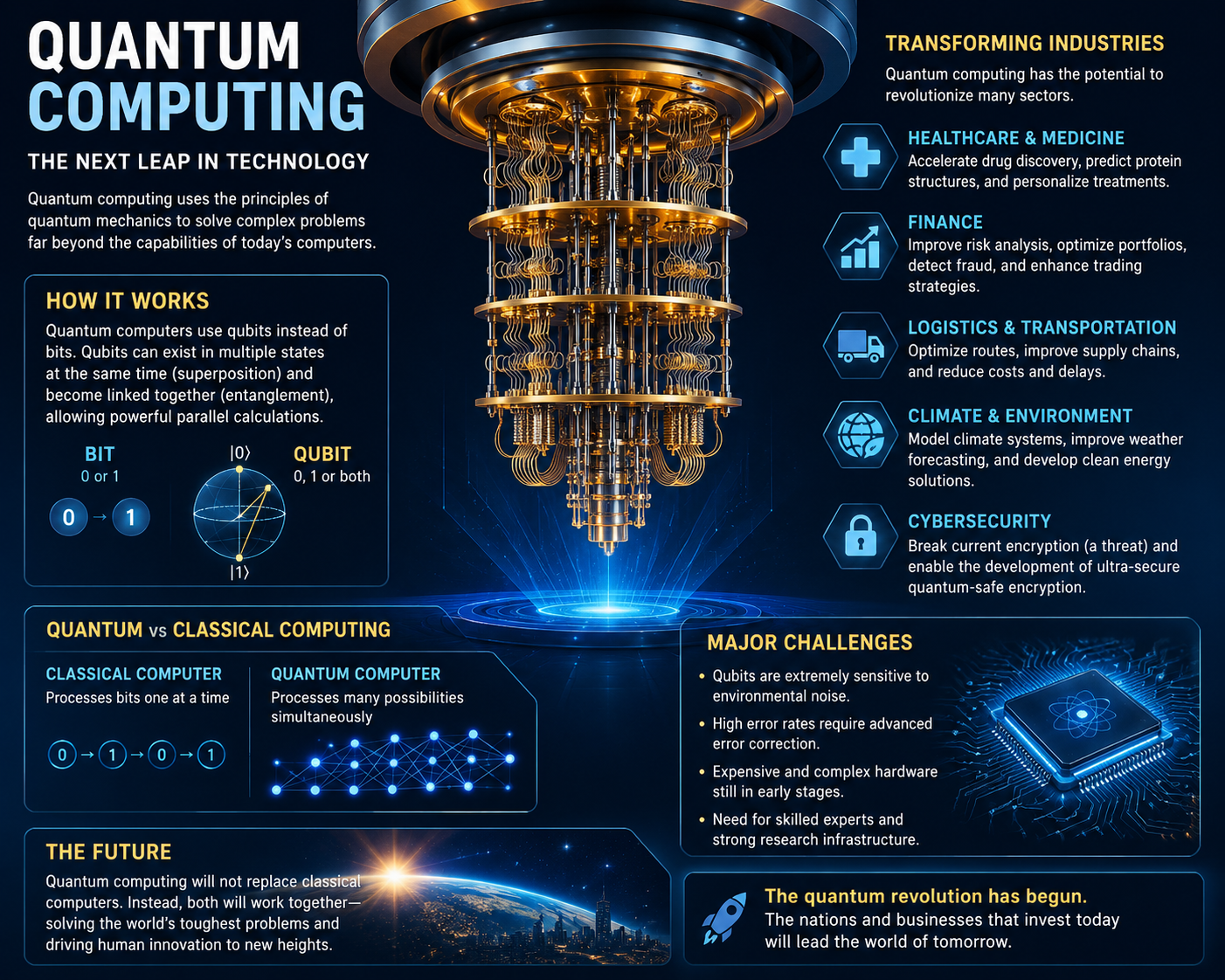
As the world enters a new era of technological innovation, quantum computing is emerging as one of the most promising and potentially disruptive technologies of the 21st century. Although still in its early stages of development, experts believe quantum computers could solve problems in minutes that would take today’s most powerful supercomputers thousands—or even millions—of years to complete.
Unlike conventional computers, which process information using binary bits represented as either 0 or 1, quantum computers use quantum bits, or qubits. Thanks to the principles of quantum mechanics, qubits can exist in multiple states simultaneously through a phenomenon known as superposition. Combined with another property called entanglement, this enables quantum computers to perform many calculations at the same time, dramatically increasing their computational power for certain types of problems.
The potential applications of quantum computing span nearly every major industry. In healthcare, researchers hope quantum computers will accelerate the discovery of new medicines by simulating complex molecular interactions far more accurately than conventional computers. This could significantly reduce the time and cost required to develop treatments for diseases such as cancer, Alzheimer’s disease, and rare genetic disorders.
The financial sector is also preparing for the quantum era. Banks and investment firms are exploring how quantum computing could improve risk analysis, fraud detection, portfolio optimization, and market forecasting. Faster and more sophisticated financial modelling could enable institutions to make better-informed investment decisions while reducing operational risks.
In manufacturing and logistics, quantum computing may revolutionize supply chain management by identifying the most efficient routes for transportation, optimizing production schedules, and reducing waste. Companies involved in aviation, shipping, and e-commerce are investing in research to understand how quantum algorithms could improve efficiency and lower operating costs.
Climate science represents another promising area. Scientists believe quantum computing could improve weather forecasting, model climate systems with greater accuracy, and accelerate the development of advanced materials for renewable energy technologies such as solar panels and high-capacity batteries. Such breakthroughs could contribute significantly to global efforts to combat climate change.
Despite its promise, quantum computing presents serious cybersecurity challenges. Much of today’s digital security depends on encryption methods that are considered extremely difficult for classical computers to break. A sufficiently powerful quantum computer could potentially decrypt some widely used encryption standards, raising concerns about the future of online banking, digital communications, government records, and critical infrastructure.
To address this risk, researchers are developing post-quantum cryptography—new encryption methods designed to remain secure even against quantum attacks. Governments, financial institutions, and technology companies are already testing these next-generation security standards to prepare for the arrival of practical quantum computers.
Developing a reliable quantum computer remains one of science’s greatest engineering challenges. Qubits are extremely sensitive to environmental disturbances such as heat, vibration, and electromagnetic interference. Even minor disruptions can introduce errors into calculations. Researchers around the world are working to improve quantum error correction, hardware stability, and scalability before large-scale commercial deployment becomes possible.
Several leading technology companies, including IBM, Google, Microsoft, and Intel, alongside numerous startups and research institutions, are investing billions of dollars in quantum research. Governments in the United States, China, the European Union, Canada, and Japan have also launched national quantum technology initiatives, recognizing its strategic importance for economic competitiveness and national security.
For Africa, quantum computing represents both a challenge and an opportunity. Although the continent currently has limited quantum research infrastructure, universities and technology institutions can begin preparing by strengthening education in mathematics, physics, computer science, and artificial intelligence. Investing in scientific research today could position African nations to participate in tomorrow’s quantum economy.
Nigeria, with its growing population of young software developers, engineers, and researchers, has the potential to contribute to quantum innovation through academic partnerships, technology incubators, and international collaborations. Building local expertise now could enable the country to benefit from future breakthroughs in computing, cybersecurity, healthcare, and advanced manufacturing.
Many experts believe that quantum computing will not replace traditional computers. Instead, both technologies are expected to work together, with classical computers handling everyday tasks while quantum systems tackle highly complex scientific, industrial, and mathematical problems.
As the technology continues to mature, quantum computing is expected to reshape industries, transform scientific discovery, strengthen economic competitiveness, and redefine global innovation. Like the internet and artificial intelligence before it, quantum computing may become one of the defining technologies of the century.
The nations and organizations that invest in quantum research today are likely to play a leading role in tomorrow’s digital economy. While practical, large-scale quantum computers may still be years away, the race to harness their extraordinary potential has already begun—and its outcome could influence the future of technology, business, and society for generations to come.
